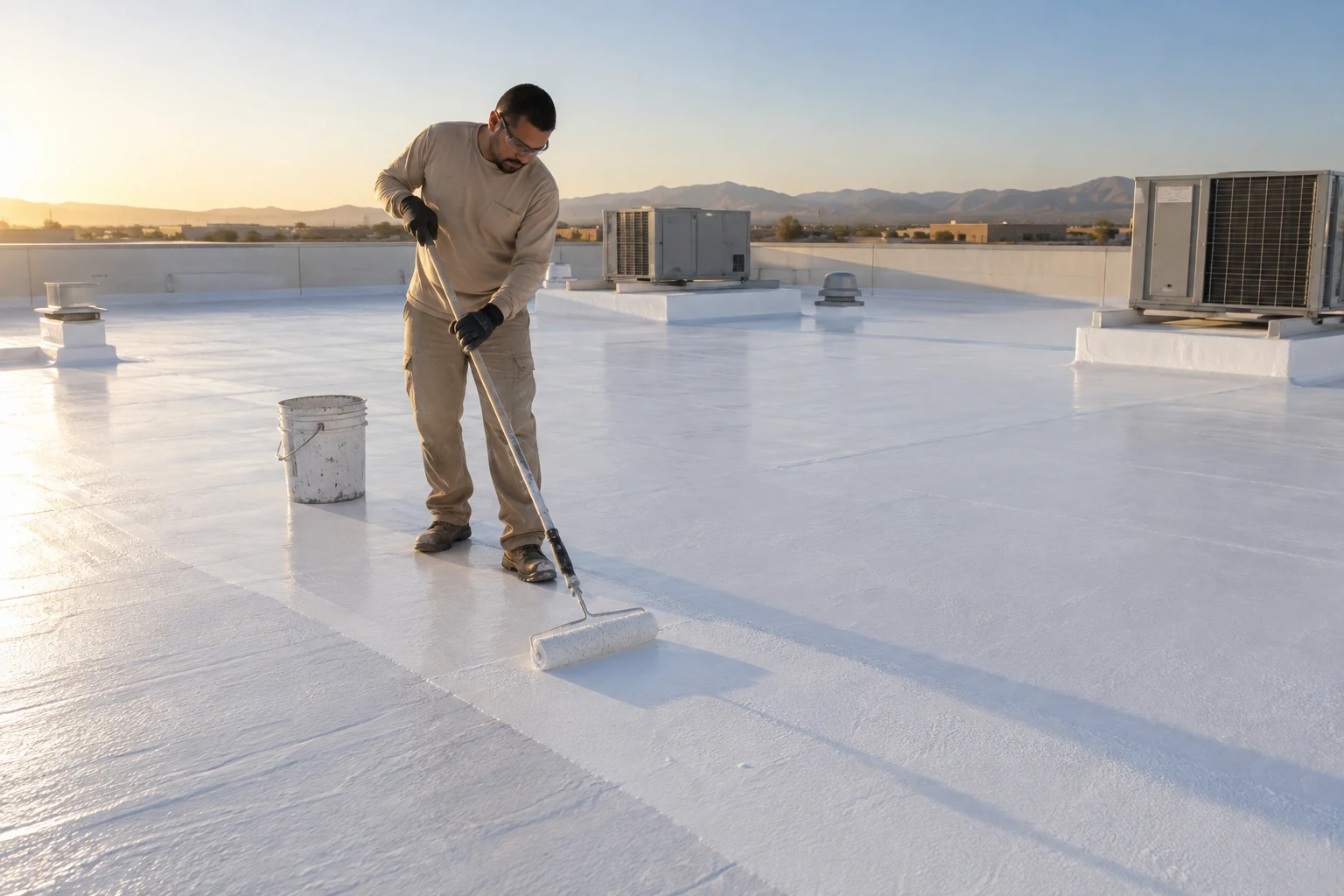
Foam And Coating Perform Different Jobs
The foam layer and the coating above it are separate parts of the roofing system. Foam forms the shaped insulating layer; the protective coating shields its surface. Treating the coating as optional leaves the system incomplete. Likewise, adding coating to damaged foam does not correct every problem within the underlying material.
The first question is whether the project concerns an existing foam roof or a different roof being considered for a new system. Those situations call for different investigations. Existing foam may need localized repairs and surface renewal, while a new application requires a broader assessment of the substrate and roof design.
Evaluate Existing Foam Carefully
An older foam roof can have localized surface damage, worn coating or areas affected by moisture. The condition and extent of those areas determine what can remain. A new top layer must not be used to hide material that needs removal or repair.
The surrounding roof matters too. Flashing at curbs and penetrations, drains, edges and connections to adjacent roofing all form part of the water-control system. A successful surface treatment depends on a scope that includes the details rather than concentrating only on the open roof field.
Establish Drainage Before Application
Foam can be incorporated into a roof design that addresses shape and drainage, but a specific drainage improvement must be planned. Spraying material across a roof does not automatically correct every low point or eliminate structural concerns. The existing assembly, loads and outlets need to be understood before deciding how the system should be formed.
Where persistent ponding or unusual movement is present, further evaluation may be needed. We explain those limits so that a coating or foam application is not mistaken for a solution to a separate problem with the building.
Coordinate The Work Area
Application conditions are important for foam and its protective coating. Weather, surface preparation and nearby operations affect the work plan. Air intakes, parked vehicles, adjacent property and rooftop equipment should be considered when defining access and protecting areas around the work.
For an occupied facility, share any restrictions on operating hours, roof access or work near ventilation equipment. These details help shape a realistic project discussion. The website does not promise uninterrupted operations or a fixed installation duration because those depend on the particular building and scope.
Benefits of Coating Your Roof
On an eligible existing foam roof, renewing the protective coating may preserve serviceable foam and avoid unnecessary removal. That can reduce waste and some of the disruption associated with replacement. Repairs still need to be completed where the existing material cannot be retained.
Future recoating may be possible when the foam, coating and details remain in suitable condition. This maintenance approach depends on periodic assessment; it is not an assurance that coating can indefinitely postpone replacement. The budget comparison should include repair and preparation needs, not only the topcoat.
Discuss A Commercial Foam Roofing Project
Tell us whether your Casa Grande property already has foam roofing and what prompted your inquiry. A leak, surface damage, a worn coating or a planned roofing improvement each suggests a different starting point. Approximate roof area and the building address help us begin, while an inspection establishes the actual condition and scope.
Our online coating calculation is a preliminary restoration model. It does not price a new foam assembly or determine insulation thickness. A project involving new foam roofing needs a site-specific estimate based on the required system and preparation.