A spray foam scope is a roof-system decision, not a quick cover-up. The existing roof must be examined for moisture, movement, loose material, drainage concerns, and areas that need repair. The foam then needs protection from the conditions the roof will face. A protective coating plan, access plan, and maintenance expectations belong in the scope before work begins.
Is Spray Foam Roofing Right For Your Casa Grande Building?
Spray foam roofing may suit a commercial building when the roof surface is secure enough to prepare, the substrate can be made dry, and the property can support controlled application. It can be considered for low-slope areas with uneven surfaces, insulation concerns, or details that require a shaped transition. A roof review should establish those conditions before anyone selects an SPF assembly.
SPF can follow contours and build a continuous roofing layer across portions of a roof, but it does not correct every underlying problem. Structural movement, wet insulation, failed drains, unstable decking, and persistent water entry require their own investigation and repair decisions. Foam applied over an unresolved defect can conceal the condition while leaving the building owner with the same roof problem.
The right comparison may include silicone roof coating for a coating-focused low-slope restoration path or metal roof coating where standing-seam panels, fasteners, and metal details control the scope. The roof assembly, access conditions, and repair boundary determine which option deserves further review.
What Spray Foam Roofing Can Address
A commercial spray foam roof review focuses on the places where a shaped, insulating roofing layer may help the roof perform as a system. The review should separate coating-ready areas from areas that need correction first.
- Uneven roof surfaces: Changes in elevation can complicate water movement and detailing. Foam can be shaped around selected transitions after the surface and drainage conditions are understood.
- Insulation concerns: SPF may become part of a plan to address thermal-layer deficiencies, subject to assembly design and substrate condition. Wet insulation still needs investigation and cannot be made sound by covering it.
- Curb details: HVAC curbs, equipment bases, and raised transitions need close preparation because movement and water entry often concentrate at these interfaces.
- Damaged coating: An existing coating that is peeling, soft, contaminated, or poorly bonded needs removal or repair decisions before foam application. Adhesion cannot be assumed from appearance alone.
- Penetrations and transitions: Pipes, curbs, edges, drains, and changes in roof plane need a detail-by-detail scope rather than a broad field application.
The useful question is where SPF can form part of a controlled roof recovery and where another repair or system path is more appropriate. A written condition record helps keep those decisions visible to the property owner and facility manager.
Benefits of Coating Your Roof
A protective topcoat is a central part of spray foam roof planning because exposed foam needs a finished surface designed for the assembly. The topcoat selection and maintenance interval should follow the approved system documentation and the roof’s actual exposure. A foam layer without a suitable protective finish is an incomplete roofing scope.
A properly planned SPF roof may offer several practical benefits for a commercial property:
- A shaped surface for detail work: Foam can follow changes around curbs and other roof transitions, giving the detail plan a defined surface to address.
- A continuous recovery layer: Where the substrate is sound and prepared, an SPF assembly may reduce the number of separate field seams across the treated area.
- A path for insulation review: Foam can be evaluated as part of a roof-and-insulation strategy when the building owner needs to address uneven or inadequate roof layers.
- Targeted restoration: The scope can identify roof areas that are suitable for recovery and keep unstable or wet areas in a separate repair decision.
- A maintainable finish: A planned protective topcoat gives the property team a surface to inspect, maintain, and recoat according to the selected assembly requirements.
These benefits depend on preparation, approved materials, sound substrate conditions, and access control. They are reasons to investigate SPF, not guarantees about a particular roof. The roof review should document what the assembly can reasonably address before a property owner commits to a work method.
Preparing The Roof For SPF Application
Preparation determines whether spray foam has a stable surface to bond to and whether hidden conditions remain hidden. The roof should be dry, secure, and reasonably clean within the limits of the selected assembly. Loose coating, deteriorated materials, contamination, standing water, and unstable details need a defined response before application begins.
A useful preparation review includes:
- Substrate condition: Identify the roof materials, exposed areas, weak sections, prior repairs, and places where the surface cannot support the proposed application.
- Moisture investigation: Check for wet insulation, trapped moisture, active entry, and areas where drying or replacement is needed. Covering wet materials moves the problem into the assembly.
- Drainage review: Observe drains, scuppers, flow paths, and low points. Foam can shape a surface, but it does not make an obstructed drain or unresolved drainage design safe.
- Detail review: Examine curbs, penetrations, edges, parapet transitions, equipment supports, and existing flashing. Each detail needs an appropriate preparation and repair boundary.
- Surface readiness: Remove or secure loose material and confirm that the selected system can bond to the prepared surface. Product-specific requirements should control the final preparation method.
Casa Grande building owners should also consider the City review process early. The Casa Grande Building Division handles commercial and industrial construction permitting and inspections. Whether a particular roof scope needs plan review, a permit, an inspection, or another city step is determined by the jurisdiction for that project. The scope should leave time to confirm those requirements before materials and work zones are scheduled.
Protecting Rooftop Equipment And Controlling Overspray
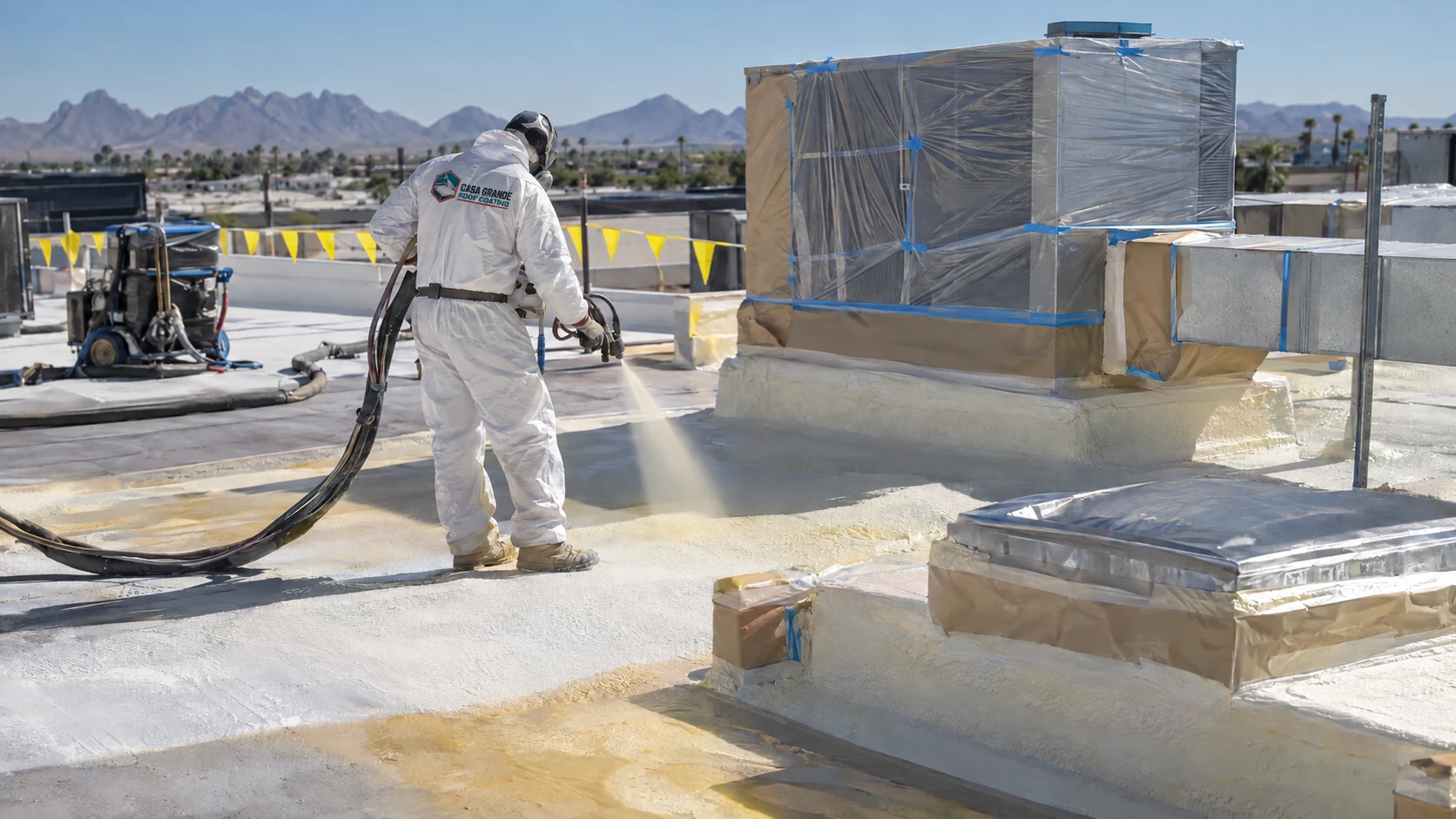
Overspray planning is a core part of commercial SPF roofing. Foam and coating application can affect nearby equipment, air intakes, vehicles, walls, windows, walkways, and occupied areas if the work zone is not controlled. A property-specific plan should identify what must be protected, isolated, shut down, relocated, or kept outside the application area.
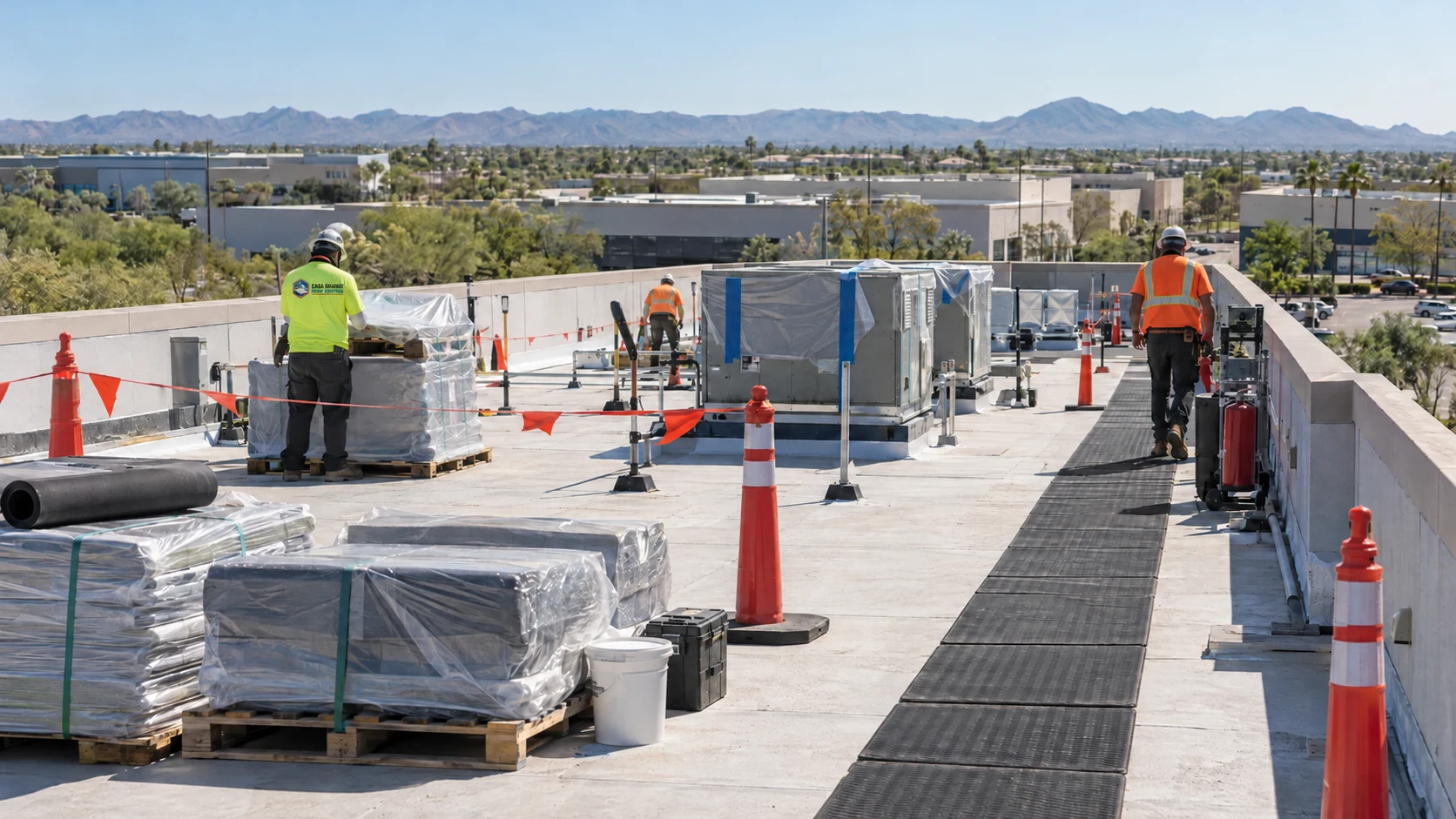
Begin with a roof access map. Mark HVAC units, exhausts, intake locations, electrical equipment, skylights, roof hatches, ladders, antennas, penetrations, and routine service paths. Note which equipment must remain available to building operations and which areas need coordination with facility staff. Keep staging, hose routing, material handling, and worker movement away from critical access points.
Overspray controls should match the building and surrounding property. The plan may include masking, temporary barriers, wind-sensitive work decisions, protected entry paths, and a defined perimeter. Adjacent tenants, customers, employees, parked vehicles, and neighboring surfaces all deserve consideration. A commercial roof cannot be treated as an isolated workbench when equipment and people operate below it.
The same plan should define how the crew will pause or adjust work when conditions change. Product instructions, the approved SPF assembly, and site controls should guide the work. A property owner should receive a clear explanation of the protected areas and any operating restrictions before application begins.
Commercial Roof Coating Options for Casa Grande
Casa Grande commercial properties can have very different roof assemblies, so spray foam should be compared with the roof’s actual condition instead of treated as a default answer. The options below describe decision paths for a roof review.
- Spray foam roofing: Consider when a dry, secure substrate, shaped transitions, insulation concerns, and controlled application justify an SPF assembly with a protective topcoat plan.
- Silicone roof coating: Consider for a low-slope coating discussion where substrate moisture, adhesion, seams, drainage, and existing coating condition can be investigated first. Read about silicone roof coating for Casa Grande.
- Metal roof coating: Consider when panel movement, corrosion, loose fasteners, seams, and penetration flashing drive the work. See Casa Grande metal roof coating for that separate decision path.
A roof may include areas that need different treatment. The final recommendation should identify repair areas, application areas, equipment restrictions, and maintenance responsibilities rather than treating every square foot as identical.
How The Spray Foam Roofing Process Works
A controlled SPF project moves from condition review to work-zone protection, application, and finished-surface planning. Each step answers a different risk before the next one begins.
Inspect Your Roof
Start with a roof walk and condition record. Review the substrate, drainage, moisture concerns, insulation questions, existing coating, curbs, penetrations, edges, and rooftop equipment. Photograph or map conditions that affect access and detail work. This first step establishes whether spray foam deserves a place in the scope.
Confirm Substrate And Scope
Separate stable areas from wet, loose, damaged, or uncertain areas. Define repairs and exclusions before application. Confirm which roof sections, transitions, curbs, and equipment bases are included. If a condition requires structural, drainage, or insulation work outside the SPF scope, record that boundary clearly.
Prepare The Work Zone
Plan access, staging, masking, barriers, equipment protection, air-intake controls, and building operations. Coordinate roof access with the facility’s daily use. Confirm how materials and hoses will reach the roof and how pedestrians, vehicles, tenants, and service technicians will stay clear of the work area.
Prepare The Roof Surface
Remove or secure loose materials, address identified repairs, and prepare the surface according to the selected assembly requirements. The surface must be dry and suitable for the work. Preparation should include details that could interrupt adhesion or direct water beneath the new roofing layer.
Apply Foam And Detail Transitions
Apply the approved SPF assembly within the defined work zone and build details around curbs, penetrations, edges, and changes in plane according to the planned method. Monitor coverage and surface conditions as work progresses. Keep unresolved defects outside the application path until they receive a decision.
Plan And Apply The Protective Topcoat
Select the protective finish for the approved assembly and roof conditions. Cover the foam consistently within the specified scope, paying attention to transitions and detail areas. Record the topcoat plan so future inspections can identify wear, damage, or areas that need maintenance.
Review The Finished Roof
Walk the completed area with the condition record and scope in hand. Check details, access paths, equipment protection, drainage observations, and the finished protective surface. Note any maintenance items or areas that need continued observation. Give the facility team practical information about roof access and future service work.
When Another Roof Decision May Fit Better
Spray foam deserves a different path when the roof has unresolved structural movement, widespread wet insulation, unstable decking, blocked drainage, or conditions that prevent a dry and secure substrate. A coating-only approach may be more suitable when the existing roof is stable and the main need is surface restoration. Metal panels with active movement or corrosion may call for a metal-focused evaluation.
Property owners should also weigh operations. A building with sensitive air intakes, nearby occupied areas, frequent rooftop service, or limited access needs a detailed work-zone plan before application is approved. If those controls cannot be maintained, the roof team should revisit the system choice and schedule.
The goal is a defensible roof decision. A review should explain what SPF may address, what repairs remain separate, how equipment will be protected, and how the finished surface will be maintained. That clarity helps a facility manager compare spray foam with other commercial roof restoration choices.
Spray Foam Roofing FAQs
Can Spray Foam Roofing Cover A Wet Roof?
No. A wet substrate or wet insulation requires investigation and a repair or replacement decision before an SPF assembly is considered. The roof must be dry and secure enough for the selected system. Covering moisture can preserve the underlying problem and make later diagnosis harder.
Does Spray Foam Fix Drainage Problems?
Spray foam may be shaped as part of a drainage strategy, but it does not automatically correct blocked drains, poor outlets, or a drainage design problem. Drains, scuppers, low points, and flow paths should be reviewed first. Any drainage work should remain a defined part of the project scope.
How Are HVAC Units Protected During SPF Work?
The work plan should map HVAC units, service clearances, exhausts, and air intakes before application. Protection may include masking, barriers, operating coordination, and controlled access. The specific controls depend on the equipment, building use, roof layout, and approved overspray plan.
Does Foam Roofing Need A Protective Coating?
Yes, the selected SPF assembly needs a suitable protective topcoat or finish plan. The finish protects the foam and gives the facility team a surface to inspect and maintain. Product and assembly requirements should determine the coating choice, coverage, and maintenance schedule.
Is SPF Roofing Suitable For Every Commercial Roof?
No. SPF suitability depends on substrate condition, moisture, roof movement, drainage, existing materials, access, equipment, and work-zone controls. A roof with unstable decking or unresolved water entry may need a different repair or replacement decision.
Does Casa Grande Require A Permit For Spray Foam Roofing?
Project-specific requirements are determined by the applicable jurisdiction. The Casa Grande Building Division handles commercial and industrial construction permitting and inspections, so the property owner should confirm the current requirements for the actual scope before work is scheduled. Safe inspection access should be planned as part of that coordination.
How Should A Facility Team Maintain A Foam Roof?
Keep roof access controlled, avoid unplanned penetrations, and inspect the protective surface and detail areas at regular intervals appropriate to the assembly. Record damage, equipment work, ponding observations, and repairs. A maintenance plan should identify who can access the roof and how new work will protect the finished surface.